Kingshill Licence and UKGC Status: What UK Players Should Know
 Available in GB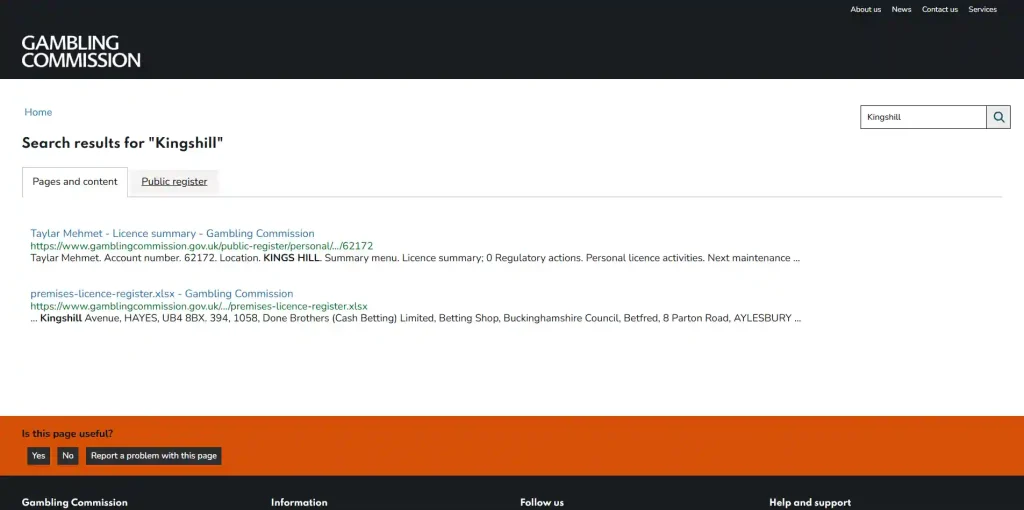
No UK Gambling Commission licence was verified for Kingshill, kingshill.com or operator IntellogixSoft B.V. in the project register check. Separately, IntellogixSoft B.V. is tied to Curaçao B2C licence reference OGL/2024/1121/1020. Those are two distinct regulatory facts and should not be blended. For consumers in England, Scotland and Wales, the UK Gambling Commission states that a business providing remote gambling to consumers in Great Britain needs a UKGC operating licence, even when the business is based overseas.
That evidence does not justify a blanket statement that Kingshill is “legal” or “illegal” across the whole United Kingdom, nor does it prove whether a particular account can currently register from a specific location. It does show why a Great Britain reader should distinguish an overseas licence from local UKGC authorisation. The relevant questions are: which entity operates the service, which regulator has issued the licence, and which consumer-protection regime applies to the activity being considered.
Table of Contents
- The evidence in one view
- What the UK Gambling Commission requires in Great Britain
- What the UKGC register check can establish
- The Curaçao reference linked to IntellogixSoft
- Why Great Britain and the United Kingdom are not interchangeable here
- What an overseas licence does not provide
- Licence status and account access are separate questions
- How to check Kingshill licensing yourself
- Why domain and trading-name checks matter
- What Kingshill’s licence position means for a Great Britain reader
The evidence in one view
| Question | Evidence-based answer |
|---|---|
| UKGC licence for Kingshill or IntellogixSoft B.V. | No UK Gambling Commission licence was verified in the project register check. |
| Great Britain rule for remote operators | Remote operators serving consumers in England, Scotland and Wales require a UKGC licence. |
| Other licence evidence | IntellogixSoft B.V. is tied to Curaçao reference OGL/2024/1121/1020. |
| Does a Curaçao reference equal UKGC authorisation? | No. They are different jurisdictions and regulatory regimes. |
| Does the UKGC no-hit prove Kingshill blocks UK accounts? | No. Account access and local licensing are separate questions. |
The most important point is the separation of evidence. A licence issued in Curaçao can establish an operator relationship and a non-UK regulatory reference. It cannot establish that the business has permission from the UK Gambling Commission to serve consumers in Great Britain. Conversely, not finding a UKGC licence is not itself proof that the website technically blocks every British visitor or rejects every British account.
What the UK Gambling Commission requires in Great Britain
The UK Gambling Commission’s remote-sector guidance is explicit: businesses providing remote gambling facilities to consumers in Great Britain need a UKGC licence. Great Britain means England, Scotland and Wales. The requirement applies even if the operator itself is based abroad. For an online casino serving those consumers, the relevant authorisation is therefore not just any gambling licence but the appropriate UKGC operating licence.
This is why a generic “licensed casino” label is not enough for a Great Britain reader. The jurisdiction matters. A site may be associated with a licence issued elsewhere, but that does not turn the foreign regulator into the British regulator or transfer the UKGC’s licence conditions to the service. When a review says only that a casino is “licensed and regulated” without naming the regulator, it leaves out the part that matters most for local protection.
The UK gambling rules page deals with the wider Great Britain framework. On this page, the narrower point is sufficient: UKGC authorisation is the local licensing question for remote gambling offered to consumers in England, Scotland and Wales.
What the UKGC register check can establish
A regulator register is stronger evidence than a marketing badge because it is maintained by the regulator. A positive match can connect a licensed business to an operating licence and can show the licence details that the register makes public. A no-hit, handled carefully, can establish that no matching local licence was verified under the searched brand, domain or known operator name at the time of the check.
For Kingshill, the project check covered the brand, kingshill.com and IntellogixSoft B.V. and did not verify a UKGC licence. That supports a precise statement: no local UK Gambling Commission licence was verified for those names. It does not support broader claims about every company that might ever be related to the brand, and it does not automatically answer the separate question of whether the site is currently accepting or rejecting registrations from a given location.
Search scope matters because brands and legal entities do not always use the same name. A robust check therefore looks at the consumer-facing brand, the domain and the named operator. If the operator changes, the check must be repeated. Licensing is not a fact to freeze permanently into a review.
The Curaçao reference linked to IntellogixSoft
IntellogixSoft B.V. is associated with Curaçao licence reference OGL/2024/1121/1020. Current Curaçao Gaming Authority material links that reference to IntellogixSoft B.V., company number 164650. That is meaningful evidence of the operator’s regulatory relationship in Curaçao, but it should be described on its own terms rather than upgraded into a UK claim.
The lifecycle wording around this licence is freshness-sensitive. Public Curaçao materials have not always presented the status in exactly the same way across every surface and snapshot. Because an exact licence status or expiry date is a high-risk detail, this page does not turn a single snapshot into a permanent statement about the current lifecycle. The safer durable claim is the operator-to-reference link itself, with the live Curaçao register used for any status check at the time a reader needs it.
This distinction prevents two common errors. The first is saying that a Curaçao reference means the casino is UKGC licensed; it does not. The second is assuming that an overseas licence is meaningless simply because it is not a UK licence. It can still identify the operator and the regulator responsible for that licence, but its consumer-protection scope is tied to that jurisdiction.
Why Great Britain and the United Kingdom are not interchangeable here
Gambling regulation creates an important geographic distinction. The UK Gambling Commission regulates commercial gambling in Great Britain, which covers England, Scotland and Wales. Northern Ireland has a distinct gambling framework, and UKGC regulation of the provision of remote gambling is not the same Northern Ireland regime.
That means a sentence such as “UK law requires every remote casino to hold a UKGC licence” is too broad. The accurate local statement is that remote operators serving consumers in Great Britain require a UKGC licence. Northern Ireland should be discussed separately rather than pulled into the Great Britain rule by shorthand.
For a reader in England, Scotland or Wales, the practical consequence is clear: the UKGC register is the relevant local licensing checkpoint. For a reader in Northern Ireland, a Great Britain licence analysis does not by itself describe the complete local position. The distinction may look technical, but it prevents a review from overstating regulator reach.
What an overseas licence does not provide
A Curaçao licence should not be presented as if it grants access to UKGC protections. Different regulators impose different licence conditions, complaint structures and enforcement mechanisms. If a service is not licensed by the UKGC, a review should not imply that the consumer is covered by the UKGC’s licence conditions, British operator obligations or a UKGC-linked dispute route through that brand.
The same caution applies to responsible-gambling schemes. A foreign licence reference is not evidence that Kingshill participates in every Great Britain-specific scheme. Those programme-level claims require their own verification. The licence page is more trustworthy when it stops at what the registers establish instead of using regulatory vocabulary as a general badge of safety.
This also explains why reputation evidence belongs elsewhere. Complaints about payouts or customer service can matter to a user’s decision, but they do not prove what licence an operator holds. The Kingshill reputation and player feedback page is the right place to assess those signals. Licence evidence should come from regulators, not from review sentiment.
Licence status and account access are separate questions
A recurring mistake in casino reviews is to treat local licensing and technical availability as the same fact. They are not. A website may be reachable from a location without holding the local licence that would be required to serve consumers there. A site may also block a region for commercial reasons even when another regulator licenses the operator. The technical result of opening a website therefore cannot substitute for a regulator search.
For Kingshill, public signals about current UK access have been mixed. That is precisely why the licence analysis should remain narrow. The lack of a verified UKGC licence can be stated. It should not be converted into a claim that every UK visitor is blocked, just as a successful page load should not be converted into a claim of local authorisation.
Readers who are primarily concerned with moving money should also keep the evidence categories separate. Withdrawal complaints and identity checks are relevant to payment risk, but they are not licence-register evidence. The withdrawal evidence and payout/KYC guide covers those issues without using them to infer regulator status.
How to check Kingshill licensing yourself
Start with the UK Gambling Commission public register if you are assessing Great Britain authorisation. Search the brand name, the domain and the named operator rather than relying on one spelling. If a matching licence appears, open the business record and check the licensed activities and domains or trading names rather than stopping at the search result.
For the Curaçao side, use the Curaçao Gaming Authority’s official material and search for IntellogixSoft B.V. or the reference OGL/2024/1121/1020. Check the live record rather than an old screenshot when the exact current status matters. If the status shown today differs from an older PDF snapshot, the live regulator record should take priority for a current decision.
Finally, compare the legal entity shown in the casino’s current terms or footer with the entity in the regulator record. If the site operator has changed, old licence research may no longer describe the current service. A logo or licence number copied into a footer is useful as a lead, but the register is what verifies the relationship.
Why domain and trading-name checks matter
Licence verification is stronger when the search is not limited to the name printed in a casino logo. Operators can use trading names, multiple domains or separate consumer brands, while the regulator record may be indexed under the legal company. That is why the Kingshill check uses the brand name, the known domain and IntellogixSoft B.V. together. A reviewer who searches only “Kingshill” could miss a company record; a reviewer who searches only the company could miss a domain association that matters to the consumer.
The reverse problem also exists: a company may hold a licence for some activity or domain without that proving that every site connected with the company is covered in the way a reader assumes. Where a regulator record exposes domain or trading-name information, those details should be matched to the service being reviewed. The correct question is not merely whether a company has ever held a gambling licence, but whether the relevant regulator record supports the specific local authorisation claim being made about the current service.
What Kingshill’s licence position means for a Great Britain reader
For someone in England, Scotland or Wales, the decisive regulatory point is that no UKGC licence was verified for Kingshill, kingshill.com or IntellogixSoft B.V., while the UKGC requires remote operators serving Great Britain consumers to hold its licence. IntellogixSoft does have a verifiable Curaçao licence reference, but that is a separate jurisdiction and should not be presented as UKGC authorisation.
The practical use of this information is not to reduce the issue to a slogan about legality. It is to understand which regulator relationship is actually evidenced and which local protections should not be assumed. A careful Great Britain reader should treat UKGC authorisation, current account access, payments and reputation as separate checks, then decide on that combined evidence rather than on a generic “licensed” badge.